
Who the Crooked Man is, how his protection racket works, why the trial is the best scene in the game, and what each sentence means.
The Crooked Man
The Crooked Man is the villain of The Wolf Among Us, and he is a very specific kind of villain: not a monster, not a mastermind, but a landlord. He runs a protection racket on fables who cannot go to the police, sells them glamour to hide what they are, and calls it a community.
That ordinariness is the point. Fabletown's real problem is not a creature in the dark; it is a man in a good suit who has worked out that desperate people will pay for safety, and that the law will look the other way as long as the paperwork is in order.
Origin
The Crooked Man comes from the English nursery rhyme: "The crooked man, he walked a crooked mile." In the Fables comics he is a fable who has made himself indispensable to the underworld of the mundane world, and the game presents him as the Crooked Man of that rhyme grown into a businessman.
His design does the character work: the purple suit, the stoop, the long fingers. He looks like a children's-book illustration that has learned to read contracts.
The operation
The Crooked Man's business has three parts:
- Protection. Fables who cannot pass for human pay him to keep their secrets, their homes and their lives intact.
- Glamour. Through suppliers like Aunty Greenleaf, he sells the magic that lets fables hide in plain sight.
- Debt. Once someone owes him, they work for him. The club, the girls, the muscle — all of it runs on obligation rather than wages.
That structure is why the case is political rather than simply criminal. He is not breaking Fabletown's law so much as operating in the space where the law does not reach, and the people who should stop him are his customers.
Why he is a good villain
The Crooked Man works because he is reasonable. He explains his position, offers deals, and frames his exploitation as a service. He never raises his voice, and he is never wrong about the facts — only about what they justify.
That makes him harder to hate than Bloody Mary and harder to dismiss than a monster. The game's smartest move is to let him talk, at length, and to make his argument sound almost convincing before the trial strips it away.
His dinner-table monologue about Fabletown's hypocrisy is the best villain writing in the game. It is also the moment the player realises he is not lying about the system — he is describing it accurately and using it as a defence.
The trial
If you bring him back alive, the Witching Well becomes a courtroom. Nerissa testifies, the Crooked Man tries to turn the proceedings, and Bigby has to decide what Fabletown's justice looks like.
The scene is the best in the season because it forces the player to choose between three kinds of ending:
- The well. The old punishment, final and storybook. It says Fabletown is still run by old rules.
- Beheading. The most violent option, and the one that makes Bigby the executioner rather than the sheriff.
- Imprisonment. The most political option. He lives, the community has a prisoner, and the sequel has a thread.
All three are defensible. None of them is framed as the "good" choice, which is why the scene lands.
Killing him at the warehouse
If you kill him on the spot, the trial never happens. Snow is furious, the epilogue is colder, and the season ends with Bigby having chosen the wolf over the badge.
It is a legitimate ending, and it is the one that makes the game's title literal. But it skips the best scene, which is why most guides recommend bringing him back at least once.
The Crooked Man in the remaster
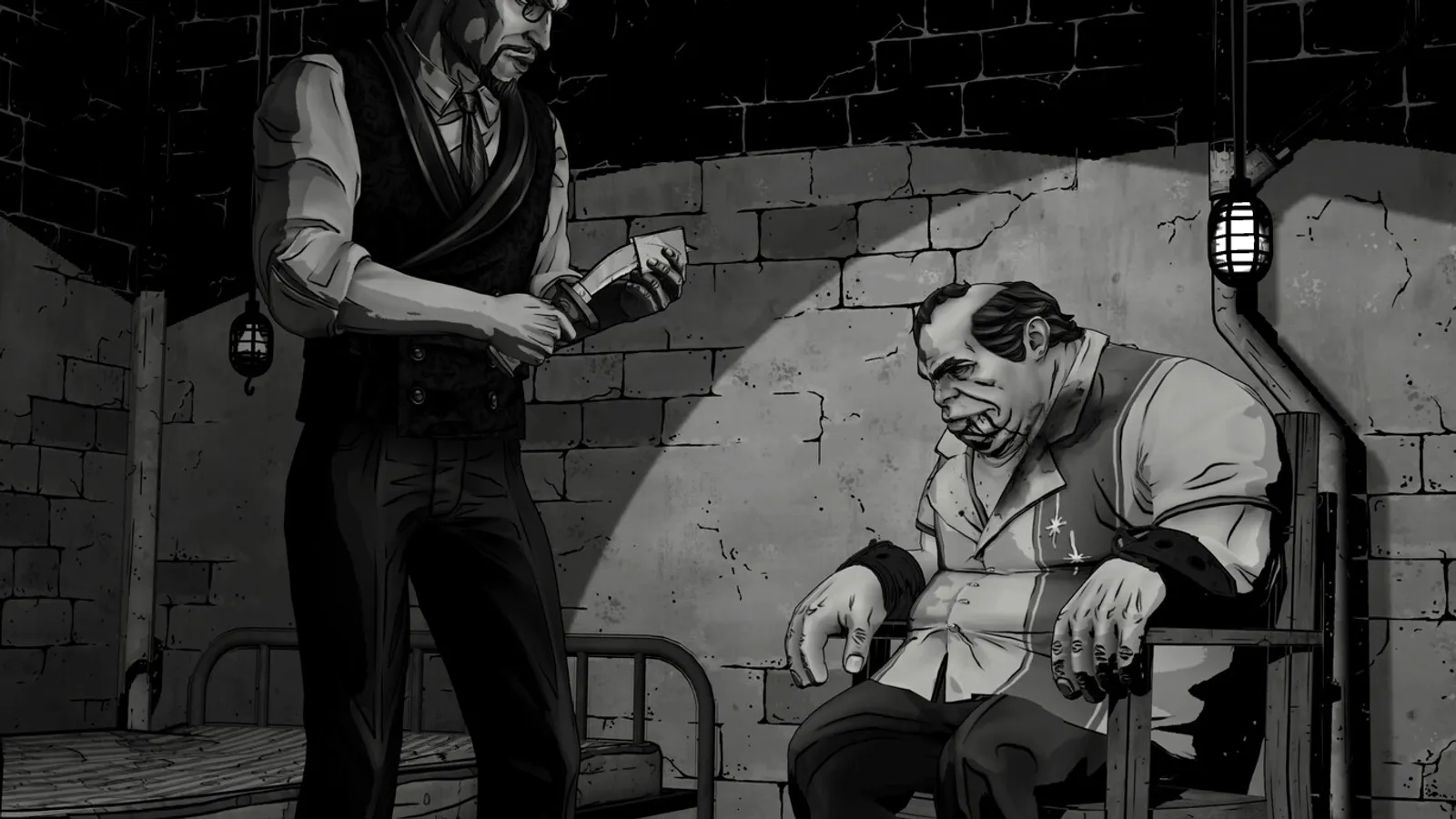
The rebuilt model adds a lot of detail to his face — the lines around the eyes, the way the suit sits — and the remaster's lighting makes him look older and more tired than the 2013 version did. That works in his favour: he reads as a man who has been running this operation for a long time.
Noir Mode suits him less well than Mary. His purple suit is part of the character's identity, and the black-and-white presentation flattens him into a generic silhouette.
Official source: The Wolf Among Us Remastered on Steam
His relationship with Mary
Mary is his enforcer, and the power dynamic is deliberately unclear. He gives her orders, but she is the one who enjoys carrying them out, and there are moments where she seems to be humouring him.
The contrast is the point: he pretends the operation is civilised, and she is the proof that it is not. Once she is dead, he has nothing left but the argument, and the trial is where the argument fails.
What his fate means for the sequel
The Wolf Among Us 2 will read the finale choices, and the Crooked Man's fate is one of the most likely threads. Imprisonment keeps him alive as a potential player; killing him closes the operation's leadership but leaves its customers and survivors.
Telltale has not said how the sequel will handle it. The save transfer guide explains how to record your choice.
FAQ
Who is the Crooked Man?
A fable from the English nursery rhyme, reimagined as a crime boss running a protection and glamour racket in Fabletown.
Can you kill the Crooked Man?
Yes. You can kill him at the warehouse, or capture him and choose a sentence at the trial.
What is the best sentence?
Imprisonment gives the most interesting epilogue and the most material for a sequel. The well and the axe are valid, bleaker endings.
Is the Crooked Man worse than Bloody Mary?
He is more responsible and less frightening. Mary is the violence; he is the system that employs it.
Bottom line
The Crooked Man is the rare villain who is scarier for being reasonable, and the trial is the scene that makes the whole season cohere. Bring him back at least once. The Bloody Mary page covers his enforcer, and the endings guide breaks down every outcome.
Sources
More The Wolf Among Us Remastered Guides
Every way Cry Wolf can end, what the Crooked Man's sentence changes, and what the Nerissa whisper actually means. Full spoilers from here.
All five episodes in order, with release order, lengths, the case each one covers and what carries into the next. No endings spoiled.
About 10 hours for the story, 12 to 14 for a completionist run, and roughly two hours per episode. Here is how the remaster's pacing breaks down.
Who Nerissa is, what she does across the season, and the evidence for every reading of her final whisper. Full spoilers for the ending.
A boxed version is coming later in the 2026 holiday season, but Telltale has not confirmed contents, platforms or price. Here is what we know.
The Wolf Among Us Remastered costs $24.99, or $19.99 with the 20% launch discount. Here is the owner discount, regional pricing and physical status.
Yes, The Wolf Among Us Remastered is on PS5. Here is the price, how the PS5 build differs from PS4, trophy support and whether an upgrade exists.
The Wolf Among Us Remastered is out now on PC, PS5 and Xbox. Here is the exact date, how launch times work, and the Switch delay.