
Who Bigby Wolf is, where he comes from, how the wolf form works, and why his restraint is the most interesting thing about the game's protagonist.
Bigby Wolf
Bigby Wolf is the Big Bad Wolf, and for the last few centuries he has been Fabletown's sheriff. He is the player character in The Wolf Among Us, which means every conversation in the game is also a conversation about whether a monster can be trusted with a badge.
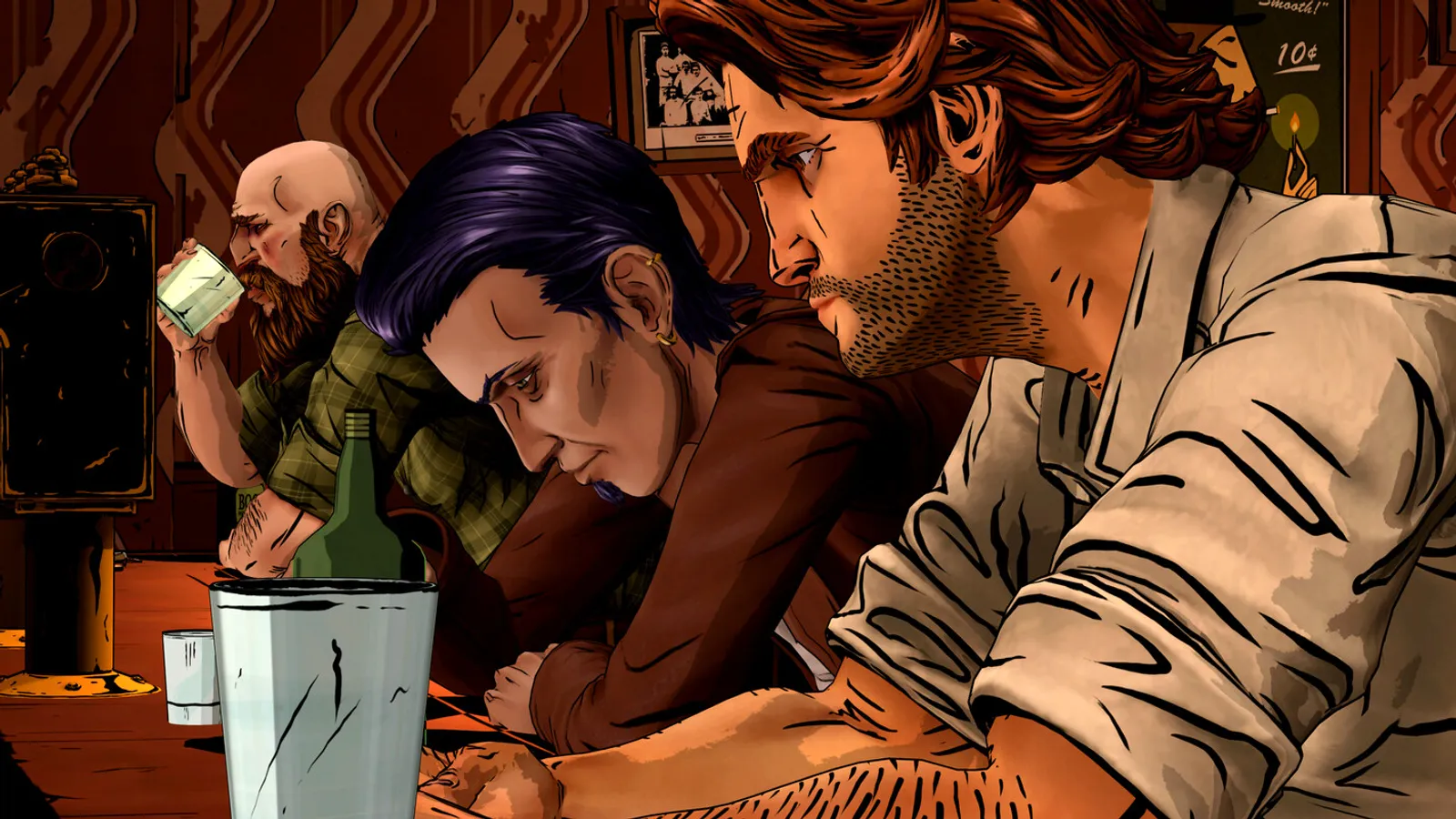
The remaster does not change him. Same dialogue, same performance by Adam Harrington, same permanent tension between the wolf and the man. What the rebuilt lighting does is make that tension visible: in the remaster's close-ups, his eyes go yellow before anything else does.
Origin and role
In the Fables comics, Bigby is the wolf from the Red Riding Hood and Three Little Pigs stories, exiled to the mundane world after the Adversary took over the homelands. He is centuries old, immensely strong, and able to shift between a man and a wolf.
In Fabletown — a Manhattan apartment building disguised as a luxury block — he is the sheriff. The job is deliberately impossible: he enforces the law on people who are stronger, older and better connected than he is, and he does it with a reputation as the monster who used to eat people.
The game is set in 1986, before the comics' main storyline, which makes Bigby younger and less settled than comics readers know him. He has a badge, a small apartment, and not much else.
Personality and writing
Bigby is written as a man performing civility. He speaks in short sentences, avoids threats he does not intend to carry out, and saves his violence for the moment the room stops listening. The game lets you push him toward patience or brutality, but it never lets him off the hook for either.
The strongest scenes are the quiet ones: Bigby and Snow in the car, Bigby and Colin in the apartment, Bigby and Nerissa in the final minutes. He is at his best when he is not being a sheriff.
Adam Harrington plays Bigby with a voice that never rises. Even the threats are delivered at conversation volume, which is why the rare shout lands like a gunshot.
The wolf form
Bigby can shift into a wolf, and the game uses it sparingly. The transformation is not a power-up; it is a loss of control, and the story treats it as evidence that the man is a costume.
The most famous use is the finale's warehouse fight, where Bigby tears Bloody Mary apart in wolf form. It is the only time the game lets the wolf fully off the leash, and it is deliberately not triumphant.
There is also a mechanic behind the fiction: Bigby's enhanced senses let him smell fear, blood and lies. The game uses this for investigation prompts, and it is the reason he can tell when a character is hiding something.
Relationships
Snow White is the most important relationship in the game. She is his handler, his conscience and, depending on your choices, something more. Her trust is the closest thing to a reputation meter, and losing it changes how the finale feels.
Colin is his housemate, a pig in a coat who criticises his choices and provides the only domestic comedy in the season.
Mr. Toad is the closest thing Bigby has to a friend in the building, which makes the case's treatment of Toad's family harder to watch.
Nerissa is the relationship the ending recontextualises. On a second playthrough, every conversation with her reads as something else.
Playing Bigby
Three practical notes if you want the character to land:
- Pick a lane. The game rewards consistency. A Bigby who threatens once and apologises the next reads as incoherent, and the characters react accordingly.
- Use the investigation prompts. Bigby's senses are the game's clue system; ignoring them makes the case feel arbitrary.
- Do not skip the quiet scenes. The car rides and apartment conversations are where the character is built. They are also where the choices that carry forward are recorded.
The best choices guide covers the route that keeps Snow's trust highest, and the choices matter page explains which decisions the sequel will read.
Bigby in the remaster
The remaster's biggest visual change is to faces, and Bigby's is the one you look at most. The rebuilt model adds detail around the eyes and jaw that the 2013 version smeared at 1080p, and the new lighting makes his wolf traits read as subtle rather than cosmetic.
Noir Mode suits him better than any other character. The black-and-white presentation turns him into a silhouette with glowing eyes, which is closer to the comics' original look than the colour version manages.
Official source: The Wolf Among Us Remastered on Steam
Is Bigby a good guy?
That is the question the game asks and refuses to answer. He is capable of real kindness and real violence, often in the same scene, and the story judges him by his choices rather than his nature. The ending's whisper is aimed directly at this: whether Bigby is "not as bad as they say" depends on what you did.
Bigby in The Wolf Among Us 2
The sequel, scheduled for 2027, will continue his story and read the choices you made in the remaster through a Telltale Account. Telltale has not detailed how much of the first game's state carries over, but the finale decisions are the obvious candidates.
The save transfer guide explains how to link your account so the sequel can see your version of Bigby.
FAQ
Who is Bigby Wolf?
The Big Bad Wolf from the Fables comics, working as sheriff of Fabletown in 1986 New York.
Who voices Bigby?
Adam Harrington, who also voiced the character in the 2013 original. The remaster keeps the original performance.
Can Bigby turn into a wolf?
Yes, and the game uses the transformation sparingly. The finale's warehouse fight is the only full transformation sequence.
Is Bigby the villain?
He is the protagonist, but the game deliberately keeps his capacity for violence in view. Whether he is a good man is left to the player's choices.
Bottom line
Bigby is Telltale's best protagonist because he is the only one whose core conflict is built into the premise: a monster enforcing the law on other monsters. Play him consistently, keep the quiet scenes, and the finale will land. The characters page covers the rest of the cast, and the walkthrough starts the case.
Sources
More The Wolf Among Us Remastered Guides
Who the Crooked Man is, how his protection racket works, why the trial is the best scene in the game, and what each sentence means.
Every way Cry Wolf can end, what the Crooked Man's sentence changes, and what the Nerissa whisper actually means. Full spoilers from here.
All five episodes in order, with release order, lengths, the case each one covers and what carries into the next. No endings spoiled.
About 10 hours for the story, 12 to 14 for a completionist run, and roughly two hours per episode. Here is how the remaster's pacing breaks down.
Who Nerissa is, what she does across the season, and the evidence for every reading of her final whisper. Full spoilers for the ending.
A boxed version is coming later in the 2026 holiday season, but Telltale has not confirmed contents, platforms or price. Here is what we know.
The Wolf Among Us Remastered costs $24.99, or $19.99 with the 20% launch discount. Here is the owner discount, regional pricing and physical status.
Yes, The Wolf Among Us Remastered is on PS5. Here is the price, how the PS5 build differs from PS4, trophy support and whether an upgrade exists.